

When I first published this blog in 2023 I never suspected gaslighting would become common. Here we are in 2026 and it’s entered today’s dating world. While chatting with my eighteen year old granddaughter the subject came up. Although she has never experienced gaslighting, one of her friends had. This conversation started me thinking about gaslighting on a larger scale.
In 1938, the title of a play added a word to the English dictionary.” Gaslight” is a thriller by British novelist and playwright Patrick Hamilton. Set in 1880s London, the new husband of a young woman plots to steal from her. It sounds simple enough, but it isn’t simple at all. The husband in the play, Jack Manningham, sets about driving his wife, Bella, insane to inherit her fortune. Every evening, Jack goes out, refusing to tell Bella where he is going. Soon after he leaves, the gas lights in the house dim. When Bella tries to talk to Jack about these strange occurrences, he convinces her she’s losing her mind.
When the play was developed as a film, the title, Gaslight, became part of the English language. The film fast became a classic with stars like Ingrid Bergman, Charles Boyer, Joseph Cotton, and a very young and beautiful Angela Lansbury in her first film role as the flirtatious housemaid. Gaslight was born! In movies based on that play, the plots involve a man attempting to drive his wife insane. He successfully isolates her from society by insisting she is too ill to socialize. His mysterious disappearances at night and his activities in the attic cause the house’s gas lights to dim. He insists to his wife that the lights are not dimming and that she can’t trust her perceptions. In the 1944 film, he is supported by the young housemaid with whom he unabashedly flirts.

Defined in the Merriam-Webster dictionary as “(1)
: to psychologically manipulate (a person), usually over an extended period of time, so that the victim questions the validity of their own thoughts, perception of reality, or memories and experiences confusion, loss of confidence and self-esteem, and doubts concerning their own emotional or mental stability: to subject (someone) to gaslighting.” (2) “the act or practice of grossly misleading someone, especially for a personal advantage.”
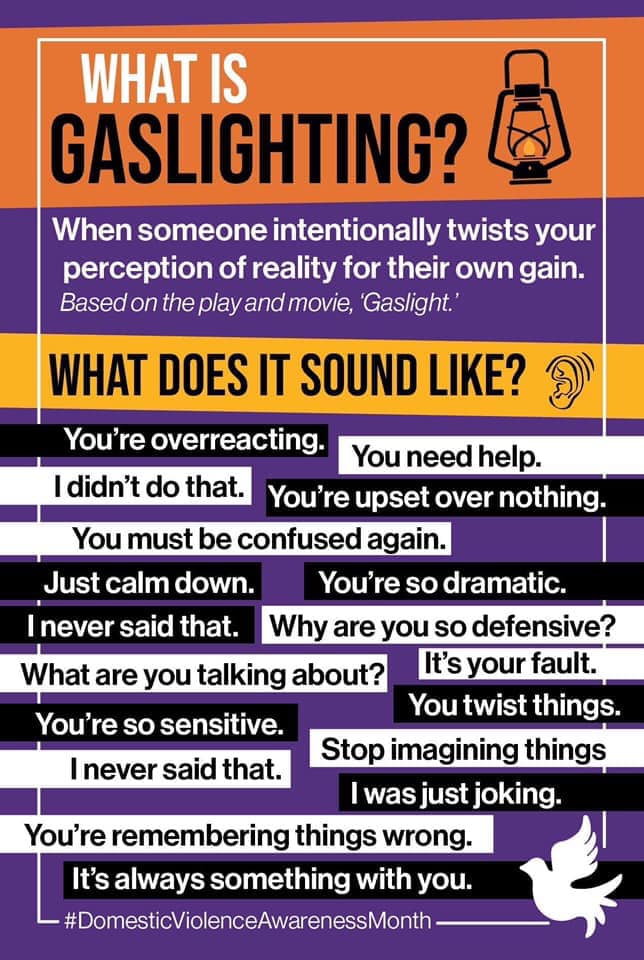
Since the 1970s, the term has been used in psychoanalytic literature to describe a “conscious intent to brainwash.” Gaslighting is a form of psychological abuse in which a person or group causes someone to question their own sanity, memories, or perception of reality. People who experience gaslighting may feel confused, anxious, or as though they cannot trust themselves.
How many people have heard and possibly used the word without knowing where it came from? Have you ever been accused of “gaslighting” someone? Have you thought someone was “gaslighting” you? If you suspect you’re being gaslighted, consider the following.
Gaslighting is a form of psychological abuse. If your partner consistently tries to convince you events you know have occurred are your imagination, conversations never happened, money or valuables are missing, and you must have lost them, insists you are too ill to socialize because others have commented negatively on your behavior then .you may be a victim of gaslighting.
According to the National Domestic Violence Hotline, gaslighting can happen in a variety of ways. Some examples include:
- “Countering: This is when someone questions a person’s memory. They may say things such as, “Are you sure about that? You have a bad memory,” or “I think you are forgetting what really happened.”
- Withholding: This involves someone pretending they do not understand the conversation, or refusing to listen, to make a person doubt themselves. For example, they might say, “Now you are just confusing me,” or “I do not know what you are talking about.”
- Trivializing: This occurs when a person belittles or disregards how someone else feels. They may accuse them of being “too sensitive” or overreacting in response to valid and reasonable concerns.
- Denial: Denial involves a person refusing to take responsibility for their actions. They may do this by pretending to forget what happened, saying they did not do it, or blaming their behavior on someone else.
- Diverting: With this technique, a person changes the focus of a discussion by questioning the other person’s credibility. For example, they might say, “That is just nonsense you read on the internet. It is not real.”
- Stereotyping: An article in the American Sociological Review says that a person may intentionally use negative stereotypes about someone’s gender, race, ethnicity, sexuality, nationality, or age to gaslight them. For example, they may say that no one will believe a woman if she reports abuse.
- According to the National Domestic Violence Hotline, gaslighting can happen in a variety of ways. Some examples include:
- Countering: This is when someone questions a person’s memory. They may say things such as, “Are you sure about that? You have a bad memory,” or “I think you are forgetting what really happened.”
- Withholding: This involves someone pretending they do not understand the conversation, or refusing to listen, to make a person doubt themselves. For example, they might say, “Now you are just confusing me,” or “I do not know what you are talking about.”
- Trivializing: This occurs when a person belittles or disregards how someone else feels. They may accuse them of being “too sensitive” or overreacting in response to valid and reasonable concerns.
- Denial: Denial involves a person refusing to take responsibility for their actions. They may do this by pretending to forget what happened, saying they did not do it, or blaming their behavior on someone else.
- Diverting: With this technique, a person changes the focus of a discussion by questioning the other person’s credibility. For example, they might say, “That is just nonsense you read on the internet. It is not real.”
- Stereotyping: An article in the American Sociological Review says that a person may intentionally use negative stereotypes about someone’s gender, race, ethnicity, sexuality, nationality, or age to gaslight them. For example, they may say that no one will believe a woman if she reports abuse.” https://www.medicalnewstoday.com/articles/gaslighting#gaslighting-examples
Those who gaslight do so to control a situation through manipulation. Gaslighters may even engage the cooperation of others like friends or family by relating their concerns for your well-being. This causes the person being gaslighted to feel uncertain and confused. As anxiety increases, the victim may become paranoid, unsure of who they can trust. This results in the victim becoming more isolated.

According to the National Domestic Violence Hotline, there are ways to combat gaslighting.
“Since gaslighting can make it difficult to feel like you truly remember what happened, it can be helpful to keep proof of the incident(s) so you can rely more on the evidence. Here are some examples of what proof you can document:
- Keep a journal — Every time you encounter something, write it down in a secret journal your partner doesn’t know about. Write down the date, time, and what happened.
- Speak to a trusted friend or family member — If you have a trusted friend or family member, telling them what happened or talking out what happened can help you clear your head, and someone else will know what is going on.
- Keep voice memos — If the abusive partner doesn’t have access to your phone, escape to a room by yourself and record yourself speaking with your phone on what just happened. If your phone isn’t a secret, tape recorders will still record sounds, and you can hide those tapes away.
- Take pictures — If the abuser doesn’t have access to your phone, take pictures of what happened to you, your child, your pet, or your stuff. The pictures will have a date and time on them in your photo gallery. If your phone isn’t a secret, you can buy a cheap disposable camera at discount stores, and hide the film from your partner.
- Email — Send your experience, voice memos, pictures, or videos to a trusted friend or family for safekeeping.”
Why keep records if you suspect you are being gaslighted? First, you have evidence to prove to yourself that you remember things correctly. You will more comfortable discussing your situation with others if you are sure and can prove what you’re saying is true. It is also useful if you need to take legal steps to remove your abuser from your life or defend yourself against untrue allegations.
For More Information:
For more advice/suggestions check out this website:
https://www.thehotline.org/resources/a-deeper-look-into-gaslighting/
https://www.medicalnewstoday.com/articles/gaslighting#gaslighting-examples
https://www.verywellmind.com/is-someone-gaslighting-you-4147470

 Between the Beats
You